-
Suicide as a Sort of Present: The Cult of DFW

A review of Every Love Story is a Ghost Story: A Life of David Foster Wallace, by D. T. Max (Viking, 2012). For the flawless. [Editor’s note: Hover over the footnotes to read them, or scroll to the bottom of the essay.] You are, unfortunately, a scholar1 of the works of the late David Foster Wallace…
-
Not Nothing: A Review of Artist’s Statements

-
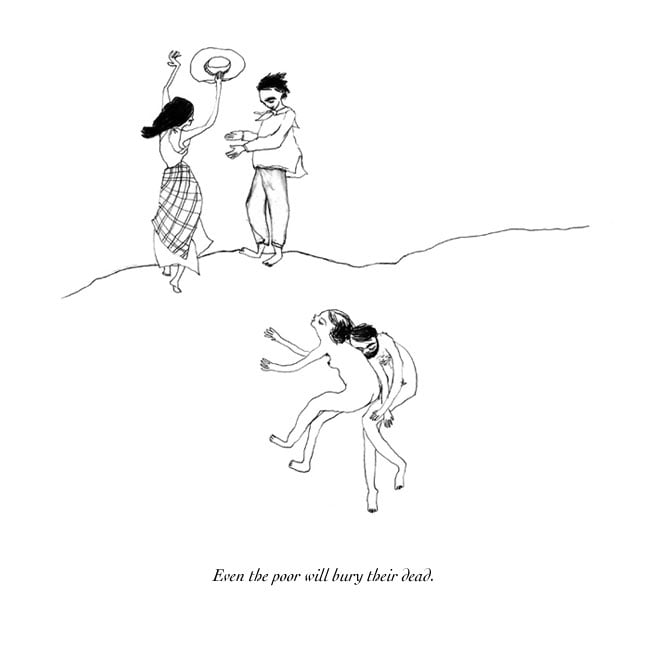
Even the Poor will Bury their Dead
-
Editor’s Note: Issue Five

This season we watched deep cuts to Library and Archives Canada begin to take effect as we learned how the archives cached by web browsers make websites load more quickly. We said goodbye to the Toronto Women’s Bookstore and Douglas and McIntyre, Canada’s biggest independent publishing house. We witnessed our sometime newspaper of record, the…
-
Confoundingly Wonderful: Martin McDonagh’s “Seven Psychopaths”

Reviewed in this essay: Seven Psychopaths, written and directed by Martin McDonagh. Starring Colin Farrell, Christopher Walken, and Woody Harrelson. Running time: 110 minutes. The trailers for Irish playwright Martin McDonagh’s third film, Seven Psychopaths, are wonderfully misleading: they present the film as a quirky gangster comedy about a dog kidnapping gone wrong. They are…
-
An infinite number of writing tips: A review of Monkeys with Typewriters

Reviewed in this essay: Monkeys with Typewriters, Scarlett Thomas, Canongate, 2012 Those who can, write; those who can’t, write how-to-write manuals. Of the thousands of fiction and screenwriting how-to books out there, far too few are by published or produced writers. In fact, this former wannabe screenwriter can’t think of a single one. Until now.
-
CanLit Canon Review #11: W.O. Mitchell’s Who Has Seen the Wind
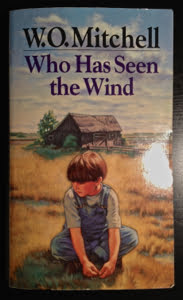
In an attempt to make himself a better Canadian, Craig MacBride is reading and reviewing the books that shaped this country. Published in 1947, W.O. Mitchell’s Who Has Seen the Wind arrived six years after As For Me and My House, Sinclair Ross’s Prairie-based depression trigger, and it has the same message as its predecessor:…
-
Bookishness: November 5, 2012

Rock (yeah) ing (yeah) chair (yeah) Rock your way to a full battery with Micasa Lab’s (still in development) ipad charging rocking chair. Canadian Poetries Promises poet secrets. How tempting. Fraaaaamed David Kaiser on the essay he didn’t write, “The essay falls in a beguiling category: the zombie fact, claims that are shown to be untrue…
-
TRB Podcast: William St Clair’s “Image and Word: Towards a Political Economy of Book Illustration”
On October 3rd, the Toronto Centre for the Book together with the Friends of Victoria Library invited Professor William St Clair to give the inaugural J.R. de Jackson Lecture for the 2012 Book History and Print Culture Lecture Series. In this lecture, titled “Image and Word: Towards a Political Economy of Book Illustration,” Prof. St…
-
An ambitious take on human nature: Edward O. Wilson’s The Social Conquest of Earth
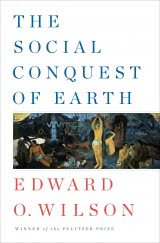
Reviewed in this essay: The Social Conquest of Earth, by Edward O. Wilson. Liveright, 2012. The first scientific controversy to capture the mind of the young Edward O. Wilson was the so-called Lysenko affair. Wilson, 14 at the time, wrote an enthusiastic essay about the Soviet biologist Trofim Lysenko, a Stalinist protégé who advocated the now…